
Fiserv sets ambitious growth targets for Clover, can it deliver?
Fiserv's Clover business saw a 30% year-over-year revenue increase in the fourth quarter of 2023, with full-year revenue reaching $2.1 billion. The company plans to boost Clover's revenue to over $4 billion by 2026 and expand its international market presence. However, analysts have differing views on the feasibility of this goal, and competitor Square is also intensifying its efforts.
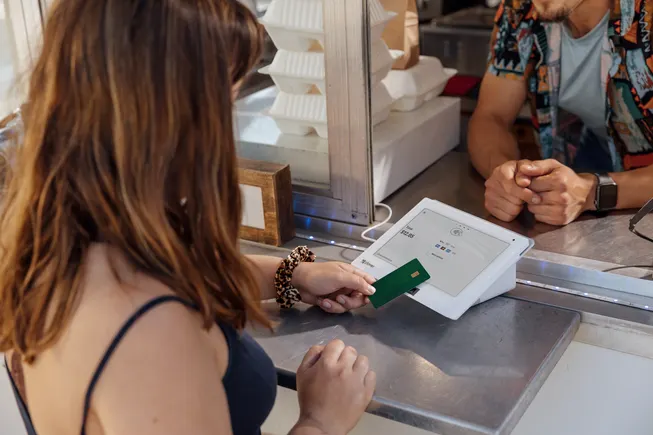
Fiserv's point-of-sale (POS) business for small and micro merchants has grown rapidly in recent years. Now, the payments giant is counting on its Clover segment for more growth, projecting that the unit's revenue will double over the next two years.
Clover is one of many industry competitors that not only offer payment acceptance services but also provide comprehensive solutions for small and medium-sized businesses. These POS providers are trying to seize the opportunity presented by the shift to cloud-based software and the wave of entrepreneurship spurred by the COVID-19 pandemic.
Clover has become a boon for payment processing giant Fiserv: its fourth-quarter revenue grew 30% year-over-year, and full-year revenue last year reached $2.1 billion, largely driven by cross-selling more services to existing merchants. Oppenheimer analyst Dominick Gabriele said Clover's strong performance has made it a key part of Fiserv's growth strategy.
"Clover is just firing on all cylinders," Gabriele said.
Milwaukee-based Fiserv has set ambitious growth targets for Clover, including expanding into international markets, and plans to achieve revenue of more than $4 billion by 2026 — a goal the company announced at its Investor Day in November.
But in the highly competitive cloud POS market (estimated by Autonomous Research at about $5 trillion), Clover is not short of competitors targeting the same retail and restaurant customers. Toast, Shift4, Shopify, Lightspeed Commerce, and Square, the merchant unit of Block, are all vying for market share from traditional POS providers such as NCR and Oracle.
Just as Fiserv seeks to accelerate Clover's growth, Jack Dorsey, the head of digital payments company Block, is also turning his attention to improving the Square business. As co-founder of Square, Dorsey took the helm of the company again in October.
"You can't underestimate Jack Dorsey's focus," Gabriele said.
San Francisco-based Square aims to move further upmarket, having reorganized its sales team last year to better keep pace with competitors. Bank of America Securities analyst Jason Kupferberg said that as Square becomes more competitive, it will become a "significant face-to-face competitor" to Clover.
Notably, Clover compares itself to Square on at least one promotional webpage aimed at restaurant operators. In serving the restaurant industry, Clover currently has 80% of Toast's functionality and plans to reach 100% by the end of this year — Bank of America Securities analysts wrote in a March 20 note to investors.
Competitors will continue to pressure Clover's goals. Analysts and consultants say that to achieve these targets, Clover needs to make progress in other countries and continue to attract merchants to use its ancillary services, such as inventory management or customer engagement.
For Fiserv, Clover achieving its growth targets is "absolutely essential," said TD Cowen analyst Bryan Bergin. "Fiserv's most important metrics come from Clover," he said. "It's arguably the crown jewel of the organization, and it can't be allowed to fail."
Clover's expansion
Dan Bjerke, Fiserv's head of global Clover business, said Clover serves about 700,000 businesses through its POS hardware and software, mainly in the restaurant, retail, and service industries, with restaurants being its largest vertical.
He revealed that about 80% to 85% of Clover merchants have annual sales between $200,000 and $250,000. Clover was acquired by First Data for $56 million in 2012, and First Data was in turn acquired by Fiserv for $22 billion in 2019.
Mizuho Securities analyst Dan Dolev noted late last year that Clover's annualized gross payment volume reached $272 billion, surpassing Square and restaurant competitor Toast. Clover runs on the Android operating system, allowing merchants to choose their own applications to help run their businesses.

"These modern platforms have a great value proposition — not just payment processing capabilities, but also the value-added software services that come with them, which create strong stickiness," Bergin noted.
This gives Fiserv confidence, projecting Clover revenue to reach $3.5 billion next year and $4.5 billion by 2026 — according to Fiserv's November investor presentation.
To achieve these goals, Fiserv seeks to add Clover customers and grow alongside them. The company expects the share of Clover revenue from value-added services (which was in the teens percentage range each quarter last year) to jump to 27% or higher by 2026.
Analysts say expanding Clover's international footprint is crucial to the plan. Clover has initial operations in Argentina, the United Kingdom, Ireland, Germany, and the Netherlands. The company plans to introduce Clover to Brazil and Mexico this year, and add Australia, Singapore, and Hong Kong markets by 2025.
"It has always been very difficult for various players to take these platforms overseas," Gabriele said. Block and PayPal have both faced difficulties in this regard. "If you can do it, that would be significant," he said.
Bjerke said in a February interview that in international expansion, Fiserv evaluates regions where the Clover brand and value proposition can resonate. The processor's history in other countries gives it an understanding of local nuances, including different payment schemes, competitive dynamics, and government regulations and compliance requirements. The company then relies on local distribution channels in those markets to sell Clover.
Fiserv's joint ventures or referral programs with certain banks, partnerships with software vendors and independent sales organizations, and direct sales experience enable it "to reach local merchants in ways others can't, and I think that's another accelerator for our growth," Bjerke said.
Clover also plans to expand in verticals where it already has a preliminary presence, such as government or education, executives said.
Bjerke declined to disclose how much Fiserv plans to invest in Clover this year. At Fiserv's Investor Day, CEO Frank Bisignano appeared to take a jab at Block, noting that Fiserv alone has 12,000 software engineers, while Block's entire organization tops out at 12,000.
Having more engineers and salespeople will be important, Gabriele said. "This is a scale business, so the more money you can put into it successfully, the better the outcome will be," he said.
Clover is increasingly important to Fiserv, especially as the company's fintech segment growth lags behind its merchant segment. UBS analyst Tim Chiodo noted in a recent report to clients that Clover accounted for about 25% of Fiserv's merchant segment revenue last year, but the company expects Clover to contribute about 75% of that segment's growth by 2026.
Analysts are divided on whether Fiserv can achieve its growth targets. Autonomous Research analyst Ken Suchoski said he has not spoken with any investors who believe Clover can achieve its 2026 revenue target.
Bank of America's Kupferberg said he wouldn't call Clover's ability to achieve its targets a "layup," but ultimately, "I wouldn't rule out Fiserv achieving these Clover targets," he said.
Square seeks simplification
Although Clover tends to serve larger merchants than Square (which started with micro-merchants), there is overlap between the two, especially as Square pursues larger customers.
As of the fourth quarter of last year, about 60% of Square's merchant customers had annualized gross payment volume (GPV) below $500,000. Of those, a slightly larger portion had annualized GPV below $125,000.

While moving upmarket, Block's merchant unit has overhauled its sales approach. Square primarily connects with customers through its website, but last year, the company reorganized its sales team vertically and added outbound salespeople. Dorsey has said the business needs to catch up with competitors in sales.
"What Clover has that Square doesn't is a sales force," said Ken Musante, founder and president of Napa Payments and Consulting. A Square spokesperson declined to make executives available for an interview and pointed to comments made on the company's recent earnings calls.
On Block's fourth-quarter earnings call last month, Dorsey hinted that the company might reconsider Square's distribution approach. When an analyst asked whether he would be open to partnering with banks or ISOs to bring Square products to market, Dorsey said executives are "absolutely open" to it.
However, Dorsey emphasized that the product itself is what matters most for Square, and he is seeking to improve the product and simplify the business.
Analysts note that Square's market share growth has slowed, and the business has not set clear growth targets like Clover has. But Square also faces growth pressure. Bergin said that in the near to medium term, Square needs to achieve 10% to 15% gross profit growth.
Bjerke largely dismissed the competitive threat from Dorsey refocusing on the Square business, saying Clover will not be "distracted." He noted that Clover benefits from Fiserv's ownership, which has the operating leverage and balance sheet to continue investing in the business.
Ultimately, "the market is large, and there are good competitive solutions in the market," Bjerke said.
To that end, despite the differences among cloud POS providers and their approaches, analysts and consultants say there is enough room in the market for multiple winners. For example, in the U.S. restaurant industry, UBS analysts estimate that about 40% to 50% of establishments still use traditional providers — according to a January report to investors.
As for Clover and Square, "I don't think it's necessarily an either-or situation," Musante said. "My expectation isn't that Clover and Square take share from each other, but that both of them take share from Shift4, FIS, and Global Payments."